
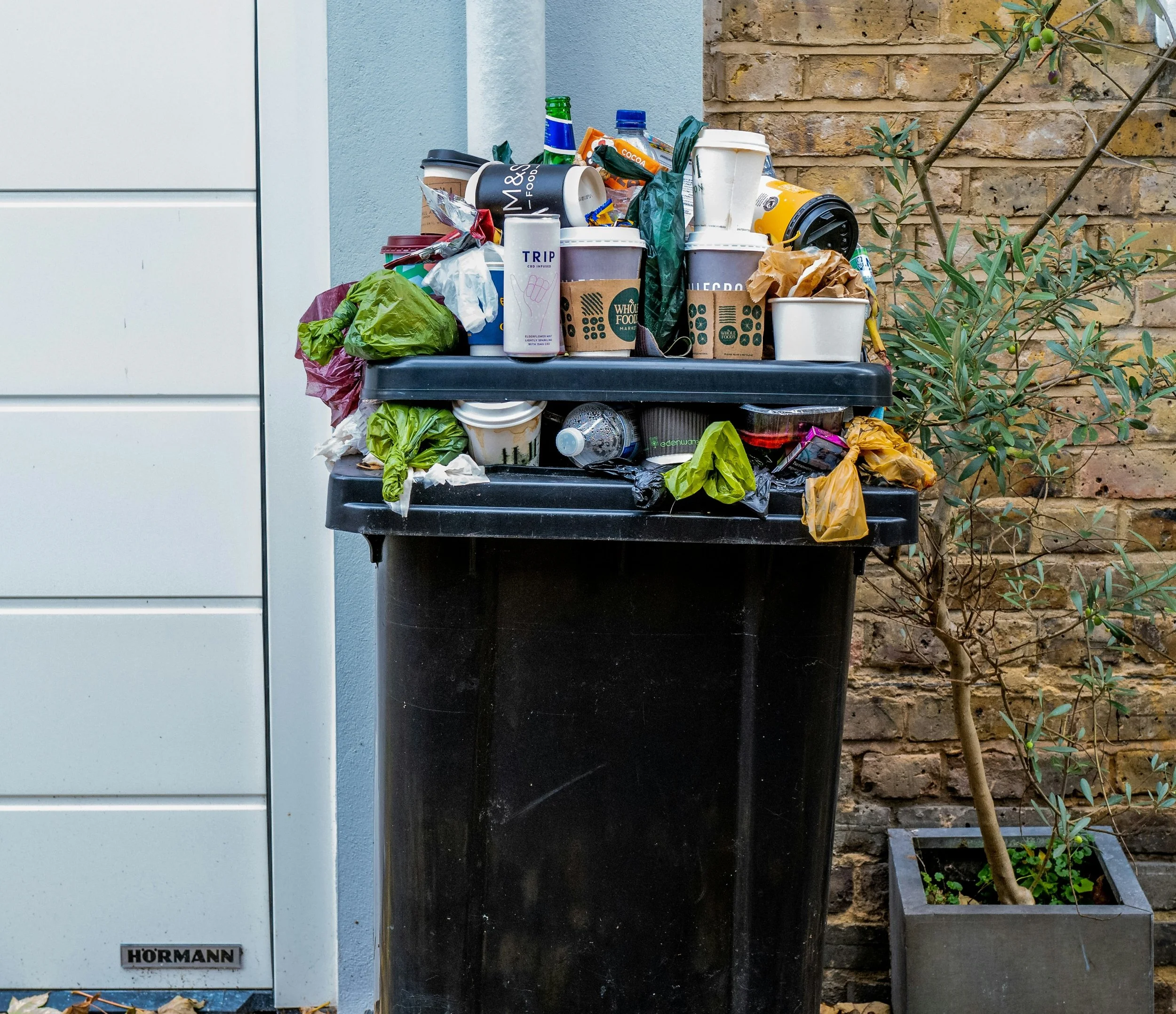
Overflowing bin / The Blowup
Waste is the most honest customer research a business has. Read through the lens of Functional Value, it shows where value is being lost, and how to turn it into growth.
In 1973, the archaeologist William Rathje started sorting household rubbish in Tucson, Arizona. His Garbage Project found that households who told interviewers they never bought beer were throwing out beer cans, and that people overstated how much cottage cheese they ate by 311% (Los Angeles Times).
What people say and what they do are different things. The bin records what they do.
Most businesses treat waste as a disposal problem or a sustainability metric. We treat it as evidence. Every product is made to do a job. Waste is the job not getting done, the meal not eaten, the jacket not worn, the course of treatment not finished. Someone paid for value that never arrived.
There is a lot of it. In 2022, the world wasted 1.05 billion tonnes of food, almost a fifth of all the food available to consumers (UNEP). Fashion, electronics and medicines tell a similar story.
That is where value is being lost. It is also where it can be found.
Measure the job, not the tonnes
Chipmakers have long tracked functional yield, the percentage of chips that pass a functional test. Every business should track its own version, measured where it counts, with the customer.
Functional Yield is the share of what you make that ends up doing the job it was made for.
It is a revealing number. Over 15 years, clothing production roughly doubled while the average number of times a garment is worn fell by 36% (Ellen MacArthur Foundation). That is an industry making more of something that does less. Among Ontario smokers using nicotine replacement therapy, 86% stopped before the recommended 8–12 weeks (American Journal of Epidemiology). Roughly one in seven used it as designed.
Functional Yield leaks in four places:
Made, not sold: surplus, overproduction, unsold stock.
Bought, not used: too much, the wrong size, forgotten, abandoned.
Used, then dropped too early: thrown away while it still works.
Finished, not recovered: by-products and materials that leave the system.
Most growth plans try to sell more units. Raising Functional Yield gets more value from the units you already make. The answer isn't always to do more. It's to create more value from what you do.
Why some industries find it harder
Three tests explain most of the difference.
Can you see it? A kitchen can weigh its waste every day. Nobody sees a half-finished course of treatment in a bathroom cabinet.
Can you reach it? Waste in your own operations is yours to fix. Waste in the customer's life needs a new product, service or partner.
Does it cost you, or pay you? When waste costs you, the business case writes itself. In a study of 1,200 food business sites, half earned USD 14 or more for every dollar invested in cutting waste. When waste is revenue, fixing it means changing how you get paid.
That gives a spectrum. Food service, food retail and food manufacturing are easier, the waste is visible, in your hands and expensive. Household food, fashion and electronics are harder. Much of the waste sits with the customer, and the model often rewards volume. Medicines are hardest. Unused prescription medicines were estimated to cost the NHS in England around £300 million a year, based on 2009 data (University of York), and once a medicine leaves the pharmacy it cannot be reused.
The hardest waste to fix is the waste you're paid for. But revenue that ends in the bin is borrowed revenue, and the loan is being called in. Regulators are calling it in. EU member states must cut food waste at retail and consumption by 30% per person by 2030 (European Commission), and large companies can no longer destroy unsold clothes and shoes in the EU (European Commission).
Competitors are calling it in too. Too Good To Go has built a community of more than 120 million registered users on other businesses' surplus (Food Nation Denmark). Meal kits sell the right amount of ingredients, in a six-country study, households wasted 38% less food cooking from a meal box than from shop-bought ingredients (The Conversation). If you don't capture the value in your waste, someone else will.
Where you act matters as much as whether you act. Europe's waste hierarchy puts prevention first and landfill last. Read it as a value hierarchy, each step down keeps less of what you made. Repair keeps the product. Recycling keeps only the material. That helps explain why Patagonia can run the largest clothing repair facility in North America, fixing about 50,000 pieces a year (Patagonia), while the textile recycler Renewcell went bankrupt in 2024 after selling less than half the pulp it needed to break even (Fortune). It has since restarted under new ownership as Circulose (The Business of Fashion).
Six ideas we'd put on the table
Each starts with the same question: what job does the customer actually need done?
Grocery: reward the food people keep
A UK household of four throws away around £1,000 of good food a year, and a quarter of the food wasted at home is binned because people cooked, prepared or served too much (WRAP). Grocers already know what each household buys. Turn that knowledge into a use-it-up service, the recipe for what is about to go off, the pack size this household actually finishes, rewards for buying right rather than buying more. Points give a little back on what people buy. Helping them use it could be worth far more, and it builds loyalty a discount can't buy.
Hospitality: read the plate
UK hospitality and food service throw away edible food worth £3.2 billion a year (WRAP). What comes back on the plate is the only customer feedback that is never polite. Weigh it by dish, then redesign portions, sides and garnishes around what people actually eat. Measurement pays, IKEA's stores halved production food waste using smart scales that record what is thrown away and why (Ingka Group), and stores typically broke even within about 20 weeks (Food Loss and Waste Protocol).
Then apply the olive test. American Airlines famously saved about USD 40,000 a year by removing one olive from each salad, betting that passengers wouldn't notice. They didn't (The New York Times). If customers won't miss it, it was never value. If they will, cutting it isn't waste reduction. It's shrinkflation.
Food and drink manufacturing: name waste by what it does
By-products are named after where they came from, so they get priced like waste. Spent grain sounds like waste. Barley protein sounds like an ingredient. EverGrain, backed by AB InBev, makes one from the other at a plant in St Louis, and its protein is used by brands including Nestlé's Garden of Life (Food Dive). Toast Brewing replaces around a quarter of its malted barley with surplus bread (Toast). Build a functional inventory of every by-product (what it contains, what it can do, who needs that) and you can see who the second customer might be.
Fashion: sell wears, not garments
Customers don't need more clothes. They need clothes that keep working. Make the number of wears the promise, design to it, guarantee it, repair to it, and buy the garment back after it. Cost per wear stops being something customers calculate and becomes something the brand commits to. Durability becomes the reason to choose you, repair and resale become revenue, and the relationship lasts as long as the garment. Patagonia's repair and trade-in programme shows the parts already work (The Seattle Times).
Electronics: sell years, not devices
The world generated 62 million tonnes of e-waste in 2022, and only 22.3% was documented as properly collected and recycled (ITU). Customers want what a device does, for as long as they need it. Keep ownership, or guarantee the buy-back, and every extra year of use becomes margin while every returned device becomes stock for a second customer. Schiphol Airport pays for light rather than buying light fittings (Signify), and the new fittings use 50% less power and last 75% longer than the ones they replaced (Signify). When you sell the function, durability becomes your margin rather than your problem.
Consumer health: design for the finish
People don't want a pack of patches. They want to quit. In the Ontario study, 47–52% of people who used nicotine replacement therapy for the recommended 8–12 weeks quit for at least a month, against 8–9% of those who stopped within four weeks (American Journal of Epidemiology). Design the product and service around the moments people drop out, and measure success in completed courses rather than packs sold. That is the thinking behind Nicotinell+, the free digital quit coach FIT developed with Nicotinell, which connects nicotine replacement therapy with personalised coaching, behavioural support and practical tools.
What FIT delivers
Find the value. Our anthropologists, scientists and strategists read waste as behaviour, combining operational and sales data with time spent where products are used. Kitchens, wardrobes, bathroom cabinets. You get a Functional Yield baseline, a map of where value leaks and why, the hidden reason behind the waste that nobody has acted on.
Build the system. We design the changes that recover the value across product, pack, portion, service, pricing, data and partners, connected so the whole business delivers the outcome, not just the unit. You get a Functional Value Blueprint with the business case attached.
Scale the value. We turn pilots into business lines, measured in the P&L: cost avoided, revenue recovered, new revenue, customers retained. With regulation moving the same way, from EU targets to England's rules requiring workplaces to separate food waste (GOV.UK), early movers set the standard others have to meet.
Start with the bin
Ask three questions. What do we throw away? What do our customers throw away? What job did it fail to do?
Answer them honestly and you will find where value is being lost. Build around the answer and you create growth that is more useful, more efficient and harder to copy.
Most agencies try to make a business more attractive. FIT makes them more valuable.
